@class指令
post by:追风剑情 2019-2-22 11:39
示例一:使用@class指令
XYPoint.h
#import <Foundation/Foundation.h>

@interface XYPoint : NSObject

@property int x, y;

-(void) setX: (int)  xVal andY: (int) yVal;

@end
XYPoint.m
#import "XYPoint.h"

@implementation XYPoint

@synthesize x, y;

-(void) setX: (int)  xVal andY: (int) yVal
{
    x = xVal;
    y = yVal;
}

@end
Rectangle.h
//
//  Rectangle.h
//  ObjectivCTest
//
//  Created by XXX on 2019/2/21.
//  Copyright © 2019 XXX. All rights reserved.
//

#import <Foundation/Foundation.h>

// 这里用@class指令告诉编译器XYPoint是个类,比导入头文件效率高。
@class XYPoint;

@interface Rectangle : NSObject

@property int width, height;

-(XYPoint *) origin;
-(void) setOrigin: (XYPoint *) pt;
-(int) area;
-(int) perimeter;
-(void) setWidth: (int) w andHeight: (int) h;

@end
Rectangle.m
#import "Rectangle.h"

@implementation Rectangle

@synthesize width, height;

// 矩形的原点坐标
XYPoint *origin;

-(XYPoint *) origin
{
    return origin;
}

-(void) setOrigin: (XYPoint *) pt
{
    origin = pt;
}

-(void) setWidth: (int) w andHeight: (int) h
{
    width = w;
    height = h;
}

// 求在积
-(int) area
{
    return width * height;
}

// 求周长
-(int) perimeter
{
    return (width + height) * 2;
}

@end
main.m
#import <Foundation/Foundation.h>
#import "Rectangle.h"
#import "XYPoint.h"

int main(int argc, const char * argv[]) {
    @autoreleasepool {
        Rectangle *myRect = [[Rectangle alloc] init];
        XYPoint *myPoint = [[XYPoint alloc] init];

        [myPoint setX: 100 andY: 200];

        [myRect setWidth: 5 andHeight: 8];
        myRect.origin = myPoint;

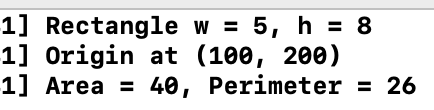
        NSLog(@"Rectangle w = %i, h = %i", myRect.width, myRect.height);
        // myRect.origin.x等价于[[myRect origin] x]
        NSLog(@"Origin at (%i, %i)", myRect.origin.x, myRect.origin.y);

        NSLog(@"Area = %i, Perimeter = %i",
              [myRect area], [myRect perimeter]);
    }
    return 0;
}
运行测试
示例二:不能使用@class的情况
XYPoint.h
#import <Foundation/Foundation.h>

@interface XYPoint : NSObject

@property int x, y;

-(void) setX: (int)  xVal andY: (int) yVal;

@end
XYPoint.m
#import "XYPoint.h"

@implementation XYPoint

@synthesize x, y;

-(void) setX: (int)  xVal andY: (int) yVal
{
    x = xVal;
    y = yVal;
}

@end
Rectangle.h
//
//  Rectangle.h
//  ObjectivCTest
//
//  Created by XXX on 2019/2/21.
//  Copyright © 2019 XXX. All rights reserved.
//

#import <Foundation/Foundation.h>

// 这里用@class指令告诉编译器XYPoint是个类,比导入头文件效率高。
//@class XYPoint;
// 因为Rectangle.m中调用了XYPoint类的方法,编译器需要知道XYPoint的更多信息,
// 所以必须导入头文件,而不能使用@class指令
#import "XYPoint.h"

@interface Rectangle : NSObject

@property int width, height;

-(XYPoint *) origin;
-(void) setOrigin: (XYPoint *) pt;
-(int) area;
-(int) perimeter;
-(void) setWidth: (int) w andHeight: (int) h;

@end
Rectangle.m
#import "Rectangle.h"

@implementation Rectangle

@synthesize width, height;

// 矩形的原点坐标
XYPoint *origin;

-(XYPoint *) origin
{
    return origin;
}

-(void) setOrigin: (XYPoint *) pt
{
    // 这里创建了XYPoint实例,
    // 那么在Rectangle.h就必须导入XYPoint.h,而不能用@class指令单纯的告诉编译器这是个类,
    // 因为编译器除了要知道XYPoint是个类之外,还是要了解XYPoint的其他信息(比如方法名及函数),所以必须导入头文件。
    if (! origin)
        origin = [[XYPoint alloc] init];

    origin.x = pt.x;
    origin.y = pt.y;
}

-(void) setWidth: (int) w andHeight: (int) h
{
    width = w;
    height = h;
}

// 求在积
-(int) area
{
    return width * height;
}

// 求周长
-(int) perimeter
{
    return (width + height) * 2;
}

@end
main.m
#import <Foundation/Foundation.h>
#import "Rectangle.h"
#import "XYPoint.h"

int main(int argc, const char * argv[]) {
    @autoreleasepool {
        Rectangle *myRect = [[Rectangle alloc] init];
        XYPoint *myPoint = [[XYPoint alloc] init];

        [myPoint setX: 100 andY: 200];

        [myRect setWidth: 5 andHeight: 8];
        myRect.origin = myPoint;

        NSLog(@"Rectangle w = %i, h = %i", myRect.width, myRect.height);
        // myRect.origin.x等价于[[myRect origin] x]
        NSLog(@"Origin at (%i, %i)", myRect.origin.x, myRect.origin.y);

        NSLog(@"Area = %i, Perimeter = %i",
              [myRect area], [myRect perimeter]);
    }
    return 0;
}
运行测试
评论:
发表评论: