奇偶校验
post by:追风剑情 2017-11-29 11:14
示例: 判断二进制串的奇偶性
using System;
using System.Collections.Generic;
using System.Linq;
using System.Text;
using System.Threading.Tasks;

namespace Test6
{
    class Program
    {
        static void Main(string[] args)
        {
            string b = "111101";
            int d = Convert.ToInt32(b, 2);
            Console.WriteLine("二进制 {0} 十进制 {1} 奇偶性 {2}", b, d, CheckParity(d));

            b = "111001";
            d = Convert.ToInt32(b, 2);
            Console.WriteLine("二进制 {0} 十进制 {1} 奇偶性 {2}", b, d, CheckParity(d));

            Console.Read();
        }

        public static int CheckParity(int x)
        {
            /**
            奇偶校验方法:
            二进制串中的每一位从左到右依次异或,因为异或满足结合律,可以用下面方法进行计算。
            **/
            //相邻位异或
            int y;
            y = x ^ (x >> 1);
            y = y ^ (y >> 2);
            y = y ^ (y >> 4);
            y = y ^ (y >> 8);
            y = y ^ (y >> 16);
            y &= 1;//最后一位决定了奇偶性(1:奇 0:偶)
            //y的第几位的奇偶性决定了最左边到此位置二进制串的奇偶性
            //如: y&2 代表了左边31位的奇偶性
            //如: y&4 代表了左边30位的奇偶性
            return y;
        }

        public static int CheckParity(byte x)
        {
            int y;
            y = x ^ (x >> 1);
            y = y ^ (y >> 2);
            y = y ^ (y >> 4);
            y &= 1;
            return y;
        }
    }
}
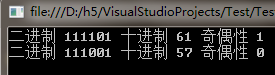
运行测试
评论:
发表评论: