RLE压缩算法
post by:追风剑情 2016-4-16 15:11
RLE(Run Length Encoding)压缩算法即行程长度压缩算法,也称游程长度压缩算法,是最早出现、也是最简单的无损数据压缩算法。RLE压缩算法对黑白图像和基于调色板的单调图像有很高的压缩效率,不仅常用于处理图像数据,在传真机上也得到了广泛的应用。
压缩格式
[长度标识位] [数据块]
长度标识位通常用一个字节标识,字节最高位为1表示后面的数据块是连续重复数据。字节最高位为0表示后面的数据块是非连续数据。把最高位除开,只有剩下的7位用来表示数据长度(即最大值是127)。
重复数据: 连续出现次数2次以上。(例如: 65, 65, 65, ...)
以下是RLE算法实现代码
using System;

/// <summary>
/// 行程长度压缩算法 RLE(Run Length Encoding)
/// 最简单的无损数据压缩算法
/// </summary>
public class RLE
{
    /// <summary>
    /// 压缩
    /// </summary>
    /// <param name="inbuf">原始数据</param>
    /// <returns>压缩后的数据</returns>
    public static byte[] Encode(byte[] inbuf)
    {
        int encSize = 0;
        int inbufPos = 0;
        int inBuffSize = inbuf.Length;
        byte[] buff = new byte[inBuffSize];

        while (inbufPos < inBuffSize)
        {
            byte count = 0;
            if (IsRepetitionStart(inbuf, inbufPos))
            {
                count = GetRepetitionCount(inbuf, inbufPos);
                //长度字节最高位设置为1
                buff[encSize++] = (byte)(count | 0x80);
                buff[encSize++] = inbuf[inbufPos];
                inbufPos += count;
            }
            else
            {
                count = GetNonRepetitionCount(inbuf, inbufPos);
                buff[encSize++] = count;
                //逐个复制这些数据
                for (int i = 0; i < count; i++)
                {
                    buff[encSize++] = inbuf[inbufPos++];
                }
            }
        }

        byte[] outbuf = new byte[encSize];
        Array.Copy(buff, 0, outbuf, 0, encSize);

        return outbuf;
    }

    /// <summary>
    /// 解压
    /// </summary>
    /// <param name="inbuf">压缩数据</param>
    /// <param name="outBuffSize">输出缓冲区大小</param>
    /// <returns>解压后的数据</returns>
    public static byte[] Decode(byte[] inbuf, int outBuffSize = -1)
    {
        int i;
        int decSize = 0;
        int count = 0;
        int inbufPos = 0;
        int inbufSize = inbuf.Length;
        if (-1 == outBuffSize)
            outBuffSize = inbufSize * 5;
        byte[] buff = new byte[outBuffSize];

        while (inbufPos < inbufSize)
        {
            byte sign = inbuf[inbufPos++];
            count = sign & 0x3F;
            //输出缓冲区空间不够了
            if (decSize + count > outBuffSize)
            {
                Console.WriteLine("错误: 输出缓冲区空间不够");
                return null;
            }

            if ((sign & 0x80) == 0x80)//连续重复数据标志
            {
                for (i = 0; i < count; i++)
                {
                    buff[decSize++] = inbuf[inbufPos];
                }
                inbufPos++;
            }
            else
            {
                for (i = 0; i < count; i++)
                {
                    buff[decSize++] = inbuf[inbufPos++];
                }
            }
        }

        byte[] outbuf = new byte[decSize];
        Array.Copy(buff, 0, outbuf, 0, decSize);

        return outbuf;
    }

    /// <summary>
    /// 是否连续三个字节数据相同
    /// </summary>
    /// <returns></returns>
    static bool IsRepetitionStart(byte[] src, int srcLeft)
    {
        if (srcLeft + 3 >= src.Length)
            return false;

        int byte1 = src[srcLeft];
        int byte2 = src[srcLeft + 1];
        int byte3 = src[srcLeft + 2];

        return (byte1 == byte2 && byte1 == byte3);
    }

    static byte GetRepetitionCount(byte[] src, int srcPos)
    {
        int endLeft = srcPos + 127;
        if (endLeft >= src.Length)
            endLeft = src.Length - 1;

        byte count = 1;
        for (int i = srcPos; i < endLeft; i++)
        {
            if (src[i] != src[i + 1])
                break;
            count++;
        }
        return count;
    }

    static byte GetNonRepetitionCount(byte[] src, int srcPos)
    {
        //只剩最后两字节数据了
        if (src.Length - srcPos <= 3)
            return 2;

        int endLeft = srcPos + 127;
        if (endLeft >= src.Length)
            endLeft = src.Length - 1;


        byte count = 0;
        for (int i = srcPos; i <= endLeft; i++)
        {
            if (IsRepetitionStart(src, i))
                break;
            count++;
        }
        return count;
    }
}
测试
using System;
using System.Collections.Generic;
using System.Linq;
using System.Text;

class Program
{
    static void Main(string[] args)
    {
        //测试数据
        byte[] data = new byte[] {
            10,
            20, 20,
            30, 30, 30,
            40, 40, 40, 40,
            50, 50, 50, 50, 50,
            60, 60, 60, 60, 60, 60,
            70, 70, 80, 80, 90
        };

        Console.WriteLine("原始数据");
        for (int i = 0; i < data.Length; i++)
            Console.Write(data[i]+", ");

        Console.WriteLine();
        Console.WriteLine("RLE压缩数据");

        byte[] en_data = RLE.Encode(data);
        for (int i = 0; i < en_data.Length; i++)
            Console.Write(en_data[i] + ", ");

        Console.WriteLine();
        Console.WriteLine("RLE解压数据");

        byte[] de_data = RLE.Decode(en_data);
        for (int i = 0; i < de_data.Length; i++)
            Console.Write(de_data[i] + ", ");

        Console.Read();
    }
}
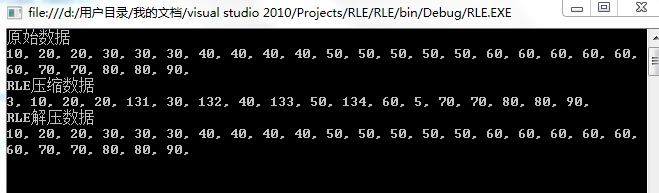
运行效果
评论:
发表评论: