把结构内容保存到文件中
post by:追风剑情 2020-3-12 10:16
示例
#define _CRT_SECURE_NO_WARNINGS
#include <stdio.h>
#include <stdlib.h>
#include <stdbool.h>
#include <string.h>

#define MAXTITL 40
#define MAXAUTL 40
#define MAXBKS 10

struct book {
	char title[MAXTITL];
	char author[MAXAUTL];
	float value;
};

char * s_gets(char * st, int n);


int main(int argc, char* argv[])
{
	struct book library[MAXBKS]; //结构数组
	int count = 0;
	int index, filecount;
	FILE* pbooks;
	int size = sizeof(struct book);

	/*
	以a+b模式打开文件,a+部分允许程序读取整个文件并在文件的末尾添加内容。b是ANSI
	的一种标识方法,表明程序将使用二进制文件格式。对于不接受b模式的UNIX系统,可以省略b,因为
	UNIX只是一种文件形式。对于早期的ANSI实现,要找出和b等价的表示法。
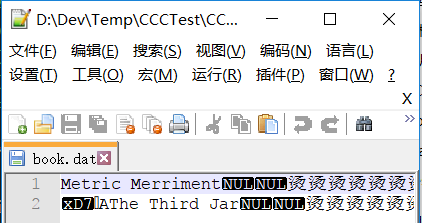
	之所以选择二进制模式是因为fread()和fwrite()函数要使用二进制文件。虽然结构中有些内容是文本,
	但是value成员不是文本。如果使用文本编辑器查看book.dat,该结构文本部分的内容显示正常,但是
	数值部分的内容不可读,甚至会导致文本编辑器出现乱码。
	rewrite()函数确保文件指针位于文件开始处,为读文件做好准备。
	*/
	if ((pbooks = fopen("book.dat", "a+b")) == NULL)
	{
		fputs("Can't open book.dat file\n", stderr);
		exit(1);
	}

	rewind(pbooks); /* 定位到文件开始位置 */
	/*
	每次把一个结构读到结构数组中,当数组已满或读完文件时停止
	fread(元素位置地址,数据块大小,每次读几块数据, 文件指针) : 返回成功读取的数据块数量
	*/
	while (count < MAXBKS && fread(&library[count], size, 1, pbooks) == 1)
	{
		if (count == 0)
			puts("Current contents of book.dat:");
		printf("%s by %s: $%.2f\n", library[count].title,
			library[count].author, library[count].value);
		count++;
	}

	filecount = count;
	if (count == MAXBKS)
	{
		fputs("The book.dat file is full.", stderr);
		exit(2);
	}

	puts("Please add new book titles.");
	puts("Press [enter] at the start of a line to stop.");
	while (count < MAXBKS && s_gets(library[count].title, MAXTITL) != NULL
		&& library[count].title[0] != '\0')
	{
		puts("Now enter the author.");
		s_gets(library[count].author, MAXAUTL);
		puts("Now enter the value.");
		scanf("%f", &library[count++].value);
		while (getchar() != '\n')
			continue; //清理输入行
		if (count < MAXBKS)
			puts("Enter the next title.");
	}

	if (count > 0)
	{
		puts("Here is the list of your books:");
		for (index = 0; index < count; index++)
			printf("%s by %s: $%.2f\n", library[index].title,
				library[index].author, library[index].value);
		fwrite(&library[filecount], size, count - filecount, pbooks);
	}
	else
		puts("No books? Too bad.\n");

	puts("Bye.\n");
	fclose(pbooks);

	system("pause");
	return 0;
}


// 自己实现读取函数
char* s_gets(char* st, int n)
{
	char* ret_val;
	int i = 0;
	ret_val = fgets(st, n, stdin);
	if (ret_val) //即,ret_val != NULL
	{
		while (st[i] != '\n' && st[i] != '\0')
			i++;
		if (st[i] == '\n')
			st[i] = '\0';
		else
			while (getchar() != '\n')
				continue;
	}
	return ret_val;
}
运行测试
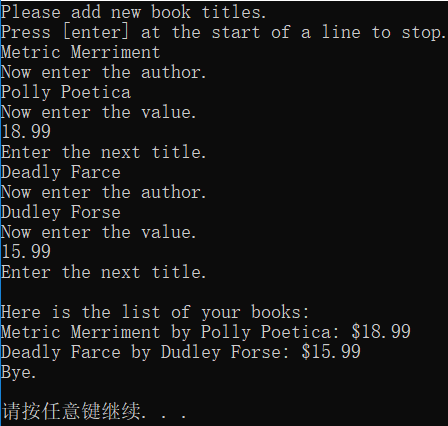
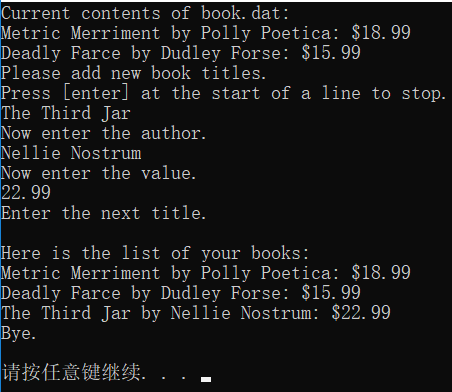
再次运行程序
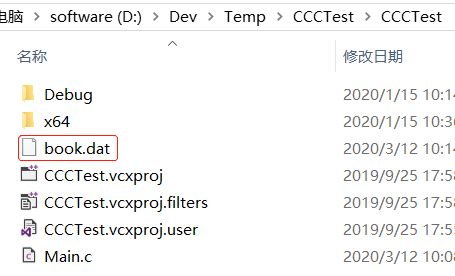
生成的二进制文件
除文本以外的数据显示为乱码
评论:
发表评论: