声明结构体
post by:追风剑情 2020-1-15 10:38
示例
#define _CRT_SECURE_NO_WARNINGS
#include <stdio.h>
#include <stdbool.h>

char* s_gets(char *st, int n);
#define MAXTITL 41 /* 书名的最大长度 + 1 */
#define MAXAUTL 31 /* 作者姓名的最大长度 + 1 */

// 结构声明可以放在所有函数外部,也可以放在函数内部
/* 声明结构(模板) */
struct book {
	//定义成员(member)或字段(field)
	char title[MAXTITL];
	char author[MAXAUTL];
	float value;
};

/*
struct book {
	char title[MAXTITL];
	char author[MAXAUTL];
	float value;
} library; //也可以这样声明结构变量
*/

/*
struct { //省略结构标记
	char title[MAXTITL];
	char author[MAXAUTL];
	float value;
} library; //也可以这样声明结构变量
*/

int main(int argc, char* argv[])
{
	//struct book library; // 声明结构体变量
	/*
	初始化一个静态存储期的结构,初始化列表中的值必须是常量。
	初始化一个自动存储期的结构,初始化列表中的值可以不是常量。
	*/
	struct book library = { // 声明结构体变量的同时初始化成员
		"The Pious Pirate and the Devious Damsel",
		"Renee Vivotte",
		1.95f
	};

	/* 结构的初始化器 (也被称为标记化结构初始化语法)
	struct book library = {
		.title = "The Pious Pirate and the Devious Damsel",
		.author = "Renee Vivotte",
		.value = 1.95
	};
	*/

	/* 普通初始化器 与 指定初始化器 混合使用
	struct book library = { // 声明结构体变量的同时初始化成员
		.value = 1.95,
		.author = "Renee Vivotte",
		2.85 //value值又被设成了2.85, 在结构体声明中因为value跟在author之后
	};*/

	printf("Please enter the book title.\n");
	s_gets(library.title, MAXTITL);
	printf("Now enter the author.\n");
	s_gets(library.author, MAXAUTL);
	printf("Now enter the value.\n");
	scanf("%f", &library.value);
	printf("%s by %s: $%.2f\n", library.title, library.author, library.value);
	printf("%s: \"%s\" ($%.2f)\n", library.author, library.title, library.value);
	printf("Done.\n");

	system("pause");
	return 0;
}

// 自己实现读取函数
char* s_gets(char* st, int n)
{
	char* ret_val;
	int i = 0;
	ret_val = fgets(st, n, stdin);
	if (ret_val) //即,ret_val != NULL
	{
		while (st[i] != '\n' && st[i] != '\0')
			i++;
		if (st[i] == '\n')
			st[i] = '\0';
		else
			while (getchar() != '\n')
				continue;
	}
	return ret_val;
}
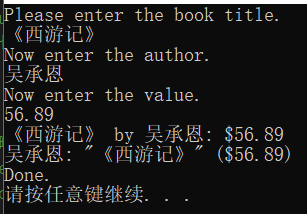
运行测试
评论:
发表评论: