委托——Delegate.CreateDelegate()
post by:追风剑情 2019-7-8 16:02
示例
using System;
using System.Collections.Generic;
using System.Linq;
using System.Text;
using System.Reflection;

namespace ReflectionMethodsCache
{
    class Program
    {
        //将方法缓存为委托,比通过反射调用Invoke()效率高
        public delegate void Fun1();
        public delegate void Fun2(string arg);
        public delegate void Fun3();
        public delegate void Fun4();
        public static Fun1 f1;
        public static Fun2 f2;
        public static Fun3 f3;
        public static Fun4 f4;

        static void Main(string[] args)
        {
            Type type = typeof(ClassA);
            //firstArgument=null,则把委托作为static方法
            MethodInfo methodInfo = type.GetMethod("Fun1");
            if (methodInfo != null)
            {
                f1 = (Fun1)Delegate.CreateDelegate(typeof(Fun1), null, methodInfo);
                f1();
            }

            methodInfo = type.GetMethod("Fun2");
            if (methodInfo != null)
            {
                f2 = (Fun2)Delegate.CreateDelegate(typeof(Fun2), null, methodInfo);
                f2("xxx");
            }

            methodInfo = type.GetMethod("Fun3");
            if (methodInfo != null)
            {
                f3 = (Fun3)Delegate.CreateDelegate(typeof(Fun3), null, methodInfo);
                f3();
            }

            //用指定的实例方法创建委托,这样创建出来的委托可访问实例变量
            ClassA classA = new ClassA();
            classA.i = 50;
            type = classA.GetType();
            methodInfo = type.GetMethod("Fun1");
            if (methodInfo != null)
            {
                f1 = (Fun1)Delegate.CreateDelegate(typeof(Fun1), classA, methodInfo);
                f1();
            }

            methodInfo = type.GetMethod("Fun4");
            if (methodInfo != null)
            {
                f4 = (Fun4)Delegate.CreateDelegate(typeof(Fun4), classA, methodInfo);
                f4();//此委托可访问classA中的实例变量
            }

            Console.ReadKey();
        }
    }

    public class ClassA
    {
        public int i = 0;

        public void Fun1()
        {
            Console.WriteLine("call Fun1");
        }

        public void Fun2(string arg)
        {
            Console.WriteLine("call Fun2, arg={0}", arg);
        }

        public static void Fun3()
        {
            Console.WriteLine("call static Fun3");
        }

        public void Fun4()
        {
            Console.WriteLine("call Fun4, i={0}", i);
        }
    }

    public class ClassB
    {

    }
}
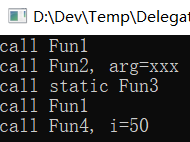
运行测试
评论:
发表评论: