语言集成查询 (LINQ)
post by:追风剑情 2019-6-28 16:18
示例一:从数组中查询数据
using System;
using System.Collections;
using System.Collections.Generic;
using System.Linq;
using System.Text;

namespace LINQ
{
    class Program
    {
        static void Main(string[] args)
        {
            //数组隐式支持泛型IEnumerable<T>接口
            int[] scores = new int[] { 97, 92, 81, 60 };

            //这句仅创建查询变量,不会执行查询
            //查询变量本身只存储查询命令,实际的查询执行会延迟到调用foreach时发生
            //查询语法查询
            IEnumerable<int> scoreQuery =
                from score in scores
                where score > 80
                orderby score
                select score;

            //对数据按奇偶分组 group by into
            IEnumerable<IGrouping<int, int>> scoreQuery2 =
                from score in scores
                where score > 80
                let g = score % 2 //通过let标识符存储计算结果
                group score by g into scoreGroup
                orderby scoreGroup.Key
                select scoreGroup;


                //调用ToList()或ToArray()会立即执行查询并缓存其结果
            int[] scoreQueryCache =
                (from score in scores
                where score > 80
                orderby score
                select score).ToArray();

            List<int> scoreQueryCache1 =
                (from score in scores
                 where score > 80
                 orderby score
                 select score).ToList();

            //方法语法查询
            //Where()等其他查询方法都是扩展方法
            //Lambda表达式 score => score > 80
            IEnumerable<int> scoreQuery1 = scores.Where(score => score > 80).OrderBy(n => n);

            //IEnumerable<T>查询编译为委托
            //IQueryable和IQueryable<T>查询编译为表达式树
            //IQueryable<T>派生自IEnumerable<T>

            //在调用foreach之前不会执行查询
            Console.WriteLine("查询语法-查询结果");
            foreach (int i in scoreQuery)
            {
                Console.Write(i + " ");
            }

            Console.WriteLine(System.Environment.NewLine);

            Console.WriteLine("方法语法-查询结果");
            foreach (int i in scoreQuery1)
            {
                Console.Write(i + " ");
            }

            Console.WriteLine(System.Environment.NewLine);

            Console.WriteLine("修改数据源后继续查询");
            scores[0] = 59;
            //这些查询方法会导致执行查询
            int count = scoreQuery.Count(); //个数
            int max = scoreQuery.Max(); //最大值
            double average = scoreQuery.Average();//平均值
            int first = scoreQuery.First();//第1个元素
            Console.WriteLine("查询结果 Count={0},Max={1}, Average={2}, First={3}",
                count, max, average, first);
            foreach (int i in scoreQuery)
            {
                Console.Write(i + " ");
            }

            Console.WriteLine(System.Environment.NewLine);

            Console.WriteLine("数据按奇偶分组查询结果");
            foreach (var groupOfScores in scoreQuery2)
            {
                Console.WriteLine(groupOfScores.Key == 1 ? "奇" : "偶");
                foreach (int i in groupOfScores)
                {
                    Console.WriteLine(i + " ");
                }
            }


            //建议尽量使用查询语法,只在必需的情况下才使用方法语法,
            //两者在性能上没有区别,只是查询语法更易读。

            Console.WriteLine(System.Environment.NewLine);
            /* 使用LINQ查询非泛型IEnumerable集合(如ArrayList) */

            ArrayList arrList = new ArrayList();
            arrList.Add(new Student() { age = 1 });
            arrList.Add(new Student() { age = 2 });

            //非泛型数据源必需指定类型 Student s
            var query = from Student s in arrList select s;
            foreach (Student s in query)
            {
                Console.WriteLine("student.age={0}", s.age);
            }

            Console.WriteLine(System.Environment.NewLine);

            //select可以返回新对象,这样可以重新定义字段
            var query1 = from Student s in arrList select new { age1 = s.age};
            foreach (var s in query1)
            {
                Console.WriteLine("obj.age1={0}", s.age1);
            }

            Console.WriteLine(System.Environment.NewLine);

            //只返回单个字段
            var query2 = from Student s in arrList select s.age ;
            foreach (var age in query2)
            {
                Console.WriteLine("age={0}", age);
            }

            Console.WriteLine(System.Environment.NewLine);
            Console.WriteLine("Press any key to exit.");
            Console.ReadKey();

            //更多查询关键字
            //https://docs.microsoft.com/zh-cn/previous-versions/bb310804%28v%3dvs.110%29
        }
    }

    public class Student
    {
        public int age;
    }
}
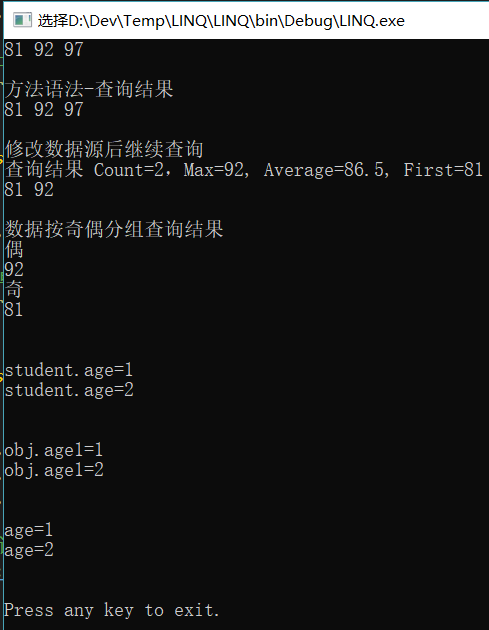
运行测试
评论:
发表评论: